

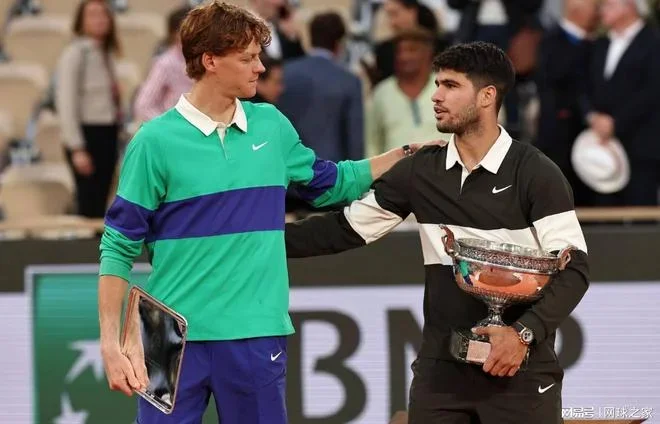
Tennis storytelling has always been built on the concept of “rivalry”—from Borg and McEnroe’s fiery clashes to Federer and Nadal’s elemental duel. Top players are expected to maintain a certain distance, even coldness, to keep fans engaged. The media craves a narrative, fans want drama, and sponsors seek clicks. So the entire industry quietly pushes every routine competition toward an “us vs. them” mentality.

But what about Sinner and Alcaraz? In a recent interview with Vanity Fair, Alcaraz dismissed that very label. When asked about his relationship with Sinner, his response was simple: “We’ve never been rivals!”
One: The racket should swing toward dreams, not become a blade
“We don’t need to be hostile toward each other, because we’re chasing the same goal. On court, we can go all out, compete fiercely, and try to beat each other. Off court, we’re two people who get along great,” Alcaraz said.
For a long time, we believed that you needed a certain level of animosity toward your opponent to strike decisively. Jordan’s “I treat them as enemies,” Kobe’s steely demeanor on the court—these became winning philosophies repeated by the next generation.

But Alcaraz is clear: don’t script drama for us. Hostility isn’t a requirement for top-tier competition, and the racket isn’t a weapon—it represents dreams.
Andre Agassi touched on similar themes in his autobiography. He said that many so-called “rivalries” are fueled by media and fan imagination. The real players rarely feel love or hatred toward each other. It’s pure competition, without personal bias.
Tennis commentator Brad Gilbert shares the view. He argues that tennis has been overdramatized over the past two decades—“Every matchup gets packaged as war, every opponent becomes a villain.” In Sinner and Alcaraz, he sees a return to a simpler era: “They remind me of what competition was like in Rod Laver’s time—warriors on court, gentlemen off it.”
Two: We are two sides of the same coin, just standing on opposite sides
“We push each other, we elevate each other, and there’s no animosity between us. We’re striving for the same goal, but there’s absolutely no need to be at odds, because our pursuits are identical,” Alcaraz said.
What does “identical pursuits” mean? McEnroe once recalled that his relationship with Connors wasn’t about not speaking—it was that they had nothing to say. “Playing the same tournaments, earning the same money, what was there to talk about besides beating each other on court?” That relationship wasn’t hate—it was indifference. Each went his own way.
Alcaraz’s “identical pursuits” are different: “We want the exact same thing, so we should be the ones who understand each other best. We could be comrades, just separated by the net.”
Nadal, when speaking about Federer in recent years, has moved from “not friends” a decade ago to “part of my life.” That slow-brewing emotion has allowed two legends to finally walk side by side at the twilight of their careers. Alcaraz and Sinner, still in their early twenties, are trying to capture that essence early. It requires a certain “innocence” from both—perhaps even rarer than talent.
Three: Competition is a delicate thing
Alcaraz is also aware of the subtle nature of his rivalry with Sinner. “At this level, maintaining a close friendship isn’t easy… but it’s not impossible. I’m completely fine with this state.”
There’s an unspoken line here: we haven’t reached that point yet. The current closeness holds partly because both are still climbing the mountain—not yet at the summit where air masks become scarce. The real test hasn’t arrived.
Boris Becker made a sharp observation in a podcast: what truly cracks the bond between rivals isn’t winning or losing itself, but that moment of psychological dissonance when one thinks, “I was supposed to win this match.”
When they start splitting Grand Slam trophies, when entourages whisper “He got this one, you must take the next,” when brands quietly compare whether to back Sinner or Alcaraz—something subtle grows. Silently, until one day it blooms into an ugly flower.
Sampras, reflecting on his relationship with Agassi, admitted to a long period of “vacuum” between them—not disharmony, but a lack of real communication. The space between them was so vast that nothing could fill it. And that vacuum coincided with the peak of their fiercest rivalry.
From another angle, Alcaraz’s “I’m completely fine with this” also hints at awareness: he knows—and we know—that ahead of them lie not just handshakes after finals, but far more complex crossroads. Maintaining closeness is never a one-way street; both must be willing, and someone must take the first step.
A well-known sports psychologist analyzed the fragility of “friendly rivalries” in a column, citing the example of McEnroe and Borg, who became close friends after retirement. But during their prime, “Borg could suffocate you with silence.” The psychological conclusion: high-intensity, equal competition naturally breeds defensive distance. Sinner and Alcaraz are trying to defy that conclusion—and everyone is watching.
Four: Don’t rush—the wine hasn’t been poured yet
Alcaraz left one of the most telling lines in the interview, worth highlighting: “Rivalry is a long process. We can’t be compared to the classic rivalries in tennis history yet. We still have a long career ahead. I hope we can face each other many times, meet in major finals, and share the biggest titles.”
Imagine, one day, the two dueling in a Grand Slam final—five sets, a deciding tiebreak. One collapses at the net in tears, while the other shakes hands, nods, and walks away, a world apart. Only then can we truly weigh the weight of Alcaraz’s words today.
In this era, top-level competition not driven by hate and not hijacked by emotion is rare. So rare that we almost can’t believe it’s real. So rare that the media still expects a crack. So rare that every time they smile together, someone suspects it’s an act.
But they are smiling.
If they can keep walking this path, the story beyond wins and losses may be more precious than victory itself. An experiment to redefine the word “rivalry” is quietly unfolding in the hands of Sinner and Alcaraz. And we are lucky to witness it.
