

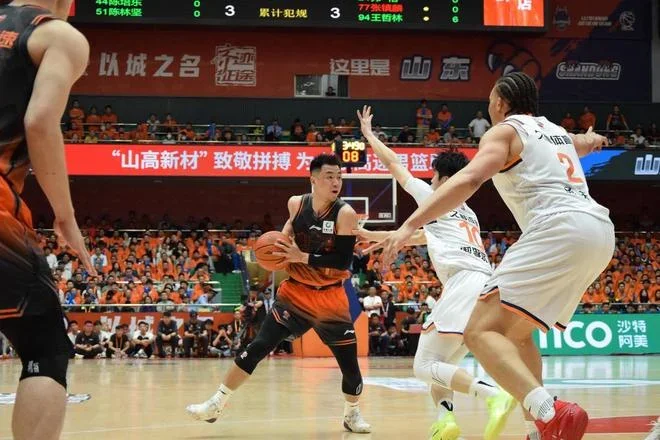
On the evening of May 9, the Shandong High-Speed men’s basketball team suffered a 68-96 home defeat to the Shanghai Sharks in Game 2 of the CBA playoff quarterfinals, being swept 0-2 and ending their season in the last eight. The 2025-2026 campaign was a rollercoaster for the team, featuring a dramatic regular season, a hard-fought play-in round victory, and ultimately a disappointing sweep in the quarterfinals.
Returning to the quarterfinals for the first time in five years, the team showcased resilience. However, the over-reliance on key players led to a wave of injuries, exposing a thin rotation that became a major obstacle to further progress.
The season began with a slow start before a strong turnaround. The coaching staff quickly adjusted the defensive system, enforcing discipline and rotation efficiency. Shandong rattled off eight consecutive wins, climbing into the upper echelon of the league. They finished third in the Club Cup, had multiple players selected for the CBA All-Star and Rising Star teams, and seemed poised for a deep run. With a solid interior defense and cohesive team play, they secured a playoff berth early, raising hopes of challenging for higher honors.
But the momentum didn’t last. A congested second half of the regular season, combined with national team duties, took a toll. The team was hit hard by injuries, disrupting their rhythm.
Key players were heavily worked: interior anchor Tao Hanlin and backcourt core Gao Shiyan frequently logged over 30 minutes per game, often playing through pain. Guard Yu Dehao’s persistent knee injury required season-ending surgery. Import player Chris suffered a finger fracture and missed 11 games. Rotation big man Guo Kai also battled injuries. With multiple key players sidelined, Shandong’s normal rotations became nearly impossible.
As head coach Qiu Biao noted, injuries were the team’s biggest challenge this season. In the latter part of the campaign, the squad was undermanned, with no reliable substitutes to share the load. Veterans were forced to grind through games, leading to exhaustion that worsened injuries and hurt both offense and defense. In the final seven games of the regular season, the depleted team won just once, sliding from a potential top-four finish to barely securing a top-eight spot.
The high intensity of the playoffs only magnified these issues. The team’s average scoring dropped from 93.2 points per game in the regular season to 82.8 in the postseason. Assists, shot attempts, and rebounds also declined significantly.
The root of the overuse of veterans lies in a combination of factors: the team’s system is heavily dependent on older players, with Gao Shiyan and Tao Hanlin serving as both scorers and tactical hubs. When they are off the court, the system breaks down. The coaching staff, wary of relying on inexperienced younger players who lack composure in critical moments, had little choice but to keep the veterans on the floor. This daily grind eventually led to injury problems.
While injuries have halted the team’s momentum on the court, they do not block the path forward. This summer, Shandong must learn from the pain. The off-season needs to focus on filling roster gaps, optimizing player development, and implementing better injury management to build a stronger foundation for next season.
